
Written by Harvey Lock
Specification Manager
Roof terraces are now a defining feature of modern developments. They add amenity, improve wellbeing and support planning requirements around social value. But there is a growing issue beneath the surface.
According to industry research, roof defects remain one of the leading causes of water ingress claims in UK buildings, often linked to failures in waterproofing or load distribution within roof build-ups. (BRE)
Too often, the roof terrace and the building envelope are designed separately. The result? Systems that look resolved above but create potential risk below.
This guide explores how roof terraces can compromise the building envelope, how to identify early warning signs, and how to prevent issues through better coordination.
Table of Contents
The disconnect in modern amenity design

In many projects, responsibilities are split:
- Structural and envelope design focuses on insulation, waterproofing and U-value requirements under UK building regulations
- Landscape design focuses on finishes such as paving, decking, planters and pedestal systems
What is often overlooked is how these systems interact.
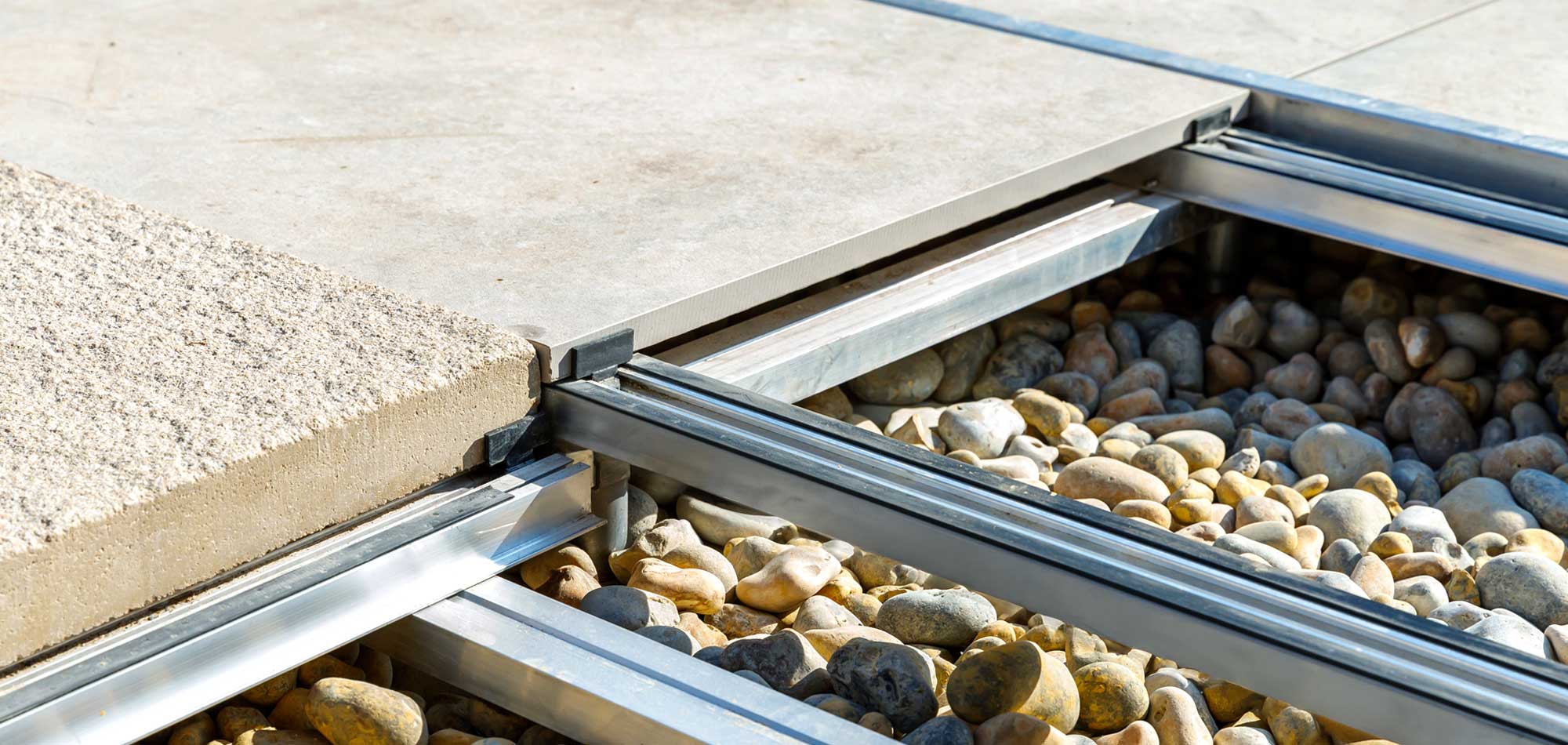
Raised paving on pedestals introduces concentrated point loads directly onto insulation layers. If insulation has been selected for thermal efficiency alone, it may not have the compressive strength required.
Hierarchy of risk
Uneven load distribution
⬇️
Insulation compression
⬇️
Movement within the build-up
⬇️
Membrane stress and deformation
⬇️
Water ingress and long-term failure

This is not a niche issue. It is increasingly common in flat roof terrace construction details across residential and commercial developments.
Studies into flat roof performance have shown that water ingress remains one of the most frequent causes of building envelope defects, particularly where load paths are poorly coordinated.
Claims data monitored by NHBC shows that roofing and superstructure defects are among the most common sources of building issues, with roofing-related failures forming a significant proportion of defect claims (RICS)
Download the Roof Terrace Book for roof terrace construction details
Thermal efficiency and structural strength
Meeting U-value targets is essential, but insulation performance is not just about thermal conductivity. It must also withstand permanent and dynamic loads.
Common issues include:
- Insulation selected without compressive strength checks
- Pedestal loads exceeding material capacity
- Long-term creep leading to settlement
The outcome is often visible at the surface level:
- Sinking paving
- Uneven finishes
- Misaligned terrace elements
This is where thermal and structural performance must be considered together, not in isolation.

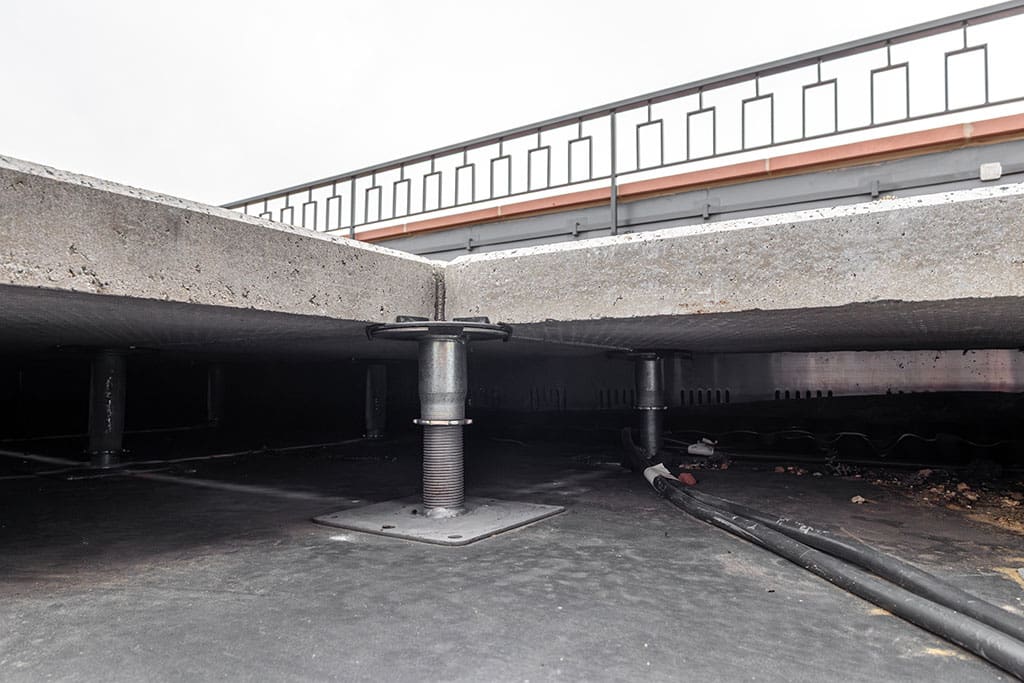
Waterproofing vulnerability
The waterproofing layer is one of the most critical parts of the building envelope. It is also one of the most vulnerable.
When loads are unevenly distributed:
- Membranes can stretch or deform
- Localised pressure points can cause damage over time
- Movement in the build-up increases risk of failure
Water ingress is rarely immediate. It develops gradually, often going unnoticed until significant damage has occurred.
Repairing failed waterproofing systems can be extremely costly. Industry cost data from organisations such as the Building Cost Information Service and guidance from the Royal Institution of Chartered Surveyors indicate that refurbishment costs for failed waterproofing systems can exceed £100–£300 per m², depending on access constraints, extent of failure and the need for removal of overlying finishes. Even where roof terrace regulations in the UK are met, failures can still occur due to poor coordination and overlooked load paths.
For more information read our recent blog: Designing from the roof up
The importance of early-stage load calculations
Many of these issues originate at the design stage.
If load distribution and build-up depth are not considered early:
- Insulation specification may be incorrect
- Finished floor levels may be compromised
- Drainage performance may be affected
Early-stage coordination, particularly at RIBA Stage 2, allows for:
- Accurate load calculations across the full system
- Alignment between pedestal design and insulation strength
- Integration with waterproofing strategy
This is especially critical for:
- Flat roof terrace conversions
- High traffic amenity spaces
- Projects with complex build-ups or limited height thresholds
The benefits of an integrated strategy

An integrated approach to roof terrace and envelope design delivers measurable benefits:
Long-term performance
Reduced risk of settlement, membrane failure and maintenance issues.
Regulatory confidence
Better alignment with roof terrace building regulations and compliance requirements.
Design integrity
Finished terraces that remain level, functional and visually consistent.
Asset value protection
Avoiding costly remediation and protecting long-term building performance.
Integrated systems also help reduce specification risk, particularly where multiple trades must coordinate within tight build-up tolerances.
How RYNO supports your building envelope
RYNO works with architects and specifiers to bridge the gap between design and performance.
We support projects through:
Early-stage specification
Aligning insulation, waterproofing and terrace systems from the outset.
Load-bearing analysis
Assessing pedestal loads and material compatibility.
System-first design approach
Ensuring all components work together as a complete build-up.
Technical guidance
Supporting flat roof terrace construction details and compliance.
Explore more:


Bridge the gap between design and performance
A roof terrace should enhance a building, not compromise it.
The issue is rarely the terrace itself. It is the disconnect between systems, disciplines and stages of design.
By considering thermal performance, structural loading and waterproofing together, architects can avoid preventable failures and deliver terraces that perform as intended.
The earlier this coordination happens, the better the outcome.
Speak to RYNO’s expert team to ensure your roof terrace supports the building envelope rather than working against it.

Harvey Lock
Specification Manager
Harvey works with architects and contractors to deliver bespoke non-combustible solutions while protecting design intent and compliance. A seafood enthusiast at heart, he is always searching for great food and never takes the slow route anywhere.