
Written by Calvin Dalrymple
Head of Technical
When roof terraces fail, it is rarely because the paving colour was wrong. It is usually because the system beneath it was not properly considered.
At concept stage, attention understandably goes to finish, format and aesthetic. But in external floor design, the pedestal system is the structural chassis. It governs load transfer, wind resistance, acoustic behaviour, drainage compliance and long-term stability.
Designing from the roof up, not the finish down, is what protects both performance and design intent.
This guide explains:
- The risks of late pedestal specification
- How pedestal performance affects the entire roof build-up
- What to consider at RIBA Stage 2
- How integrated systems reduce coordination risk
- Why longevity matters more than day-one compliance
The expert insight in this article comes from Calvin, RYNO’s technical lead, who supports architects, contractors and engineers across high-rise residential, hospitality and modular balcony schemes.
As Calvin explains:
“Pedestals aren’t just supports. They’re load-transfer components sitting directly on insulation and waterproofing. If you don’t engineer them early, you’re introducing risk into the entire roof assembly.”
Table of Contents
- The Risks of a Late Specification Approach
- What Does Pedestal Performance Actually Affect?
- Load and Tolerance
- Acoustics
- Wind Uplift
- The Specification Checklist: Key Questions to Ask Early
- How Integrated Systems Reduce Coordination Issues
- Designing for Longevity, Not Just Compliance
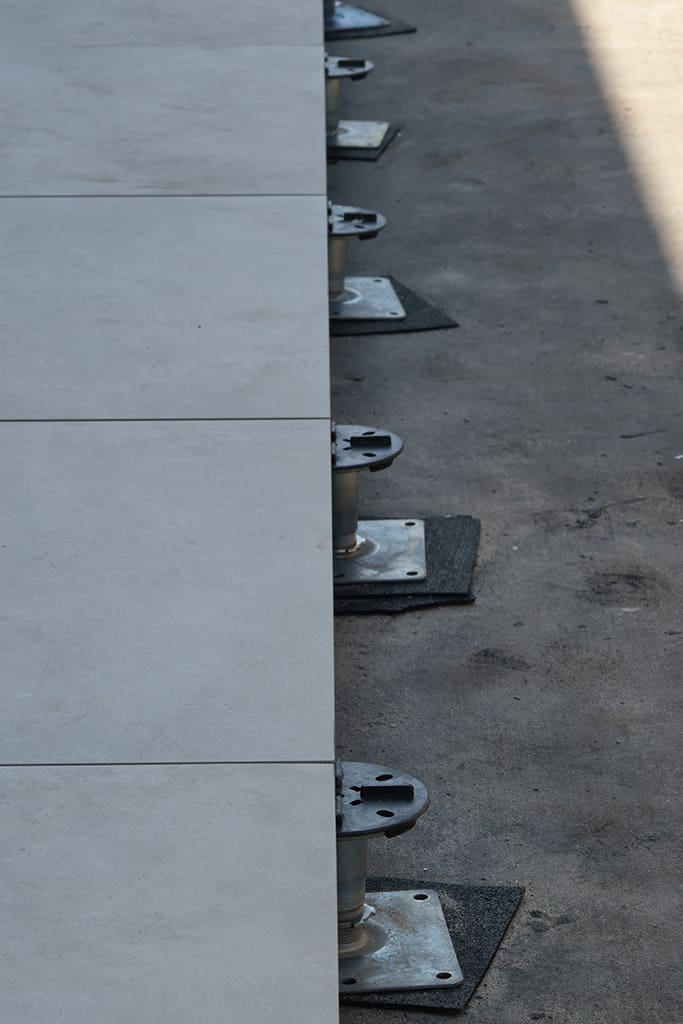
The Risks of a ‘Late Spec’ Approach
Picture
Pedestal systems are still too often treated as a commodity line item. They appear on drawings as placeholders, added once build-up heights, thresholds and drainage have already been fixed.
By that point:
- Build-up heights are tight
- Insulation specification is defined
- Drainage falls are locked in
- Usage loads are unresolved
- Wind uplift calculations are pending
This forces the pedestal system to adapt to constraints it should have helped shape.
A late specification approach commonly leads to:
- Compromised build-up heights
- Expensive last-minute engineering adjustments
- Conflicts with waterproofing warranties
- Increased risk of surface movement
- Poor long-term acoustic performance
Calvin regularly sees this in practice:
“If pedestals are only being discussed at RIBA Stage 4, the project is already reacting instead of designing. We end up solving problems that originated two stages earlier.”
For example, on a recent high-rise residential scheme, wind uplift calculations undertaken at Stage 4 required additional ballast weight. The build-up allowance wasn’t sufficient. The result? Redesign of thresholds and delayed procurement.
Early specification at RIBA Stage 2 concept design allows the pedestal system to inform the roof build-up, not fight it.
What Does Pedestal Performance Actually Affect?
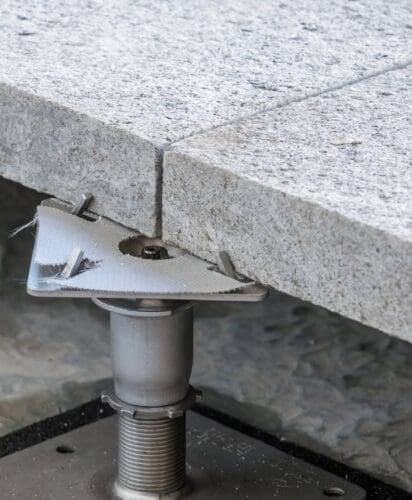
Pedestals are not simply adjustable supports. They are load-transfer devices positioned directly above insulation and waterproofing. Their performance affects the entire roof assembly.
Calvin explains:
“Every load on that terrace passes through the pedestal before it reaches the structure. If the pedestal isn’t engineered properly, neither is the terrace.”
Load and Tolerance
External floor systems must handle both static and dynamic roof load conditions.
- Static loads: paving weight, planters, furniture
- Dynamic loads: foot traffic, events, crowd loading
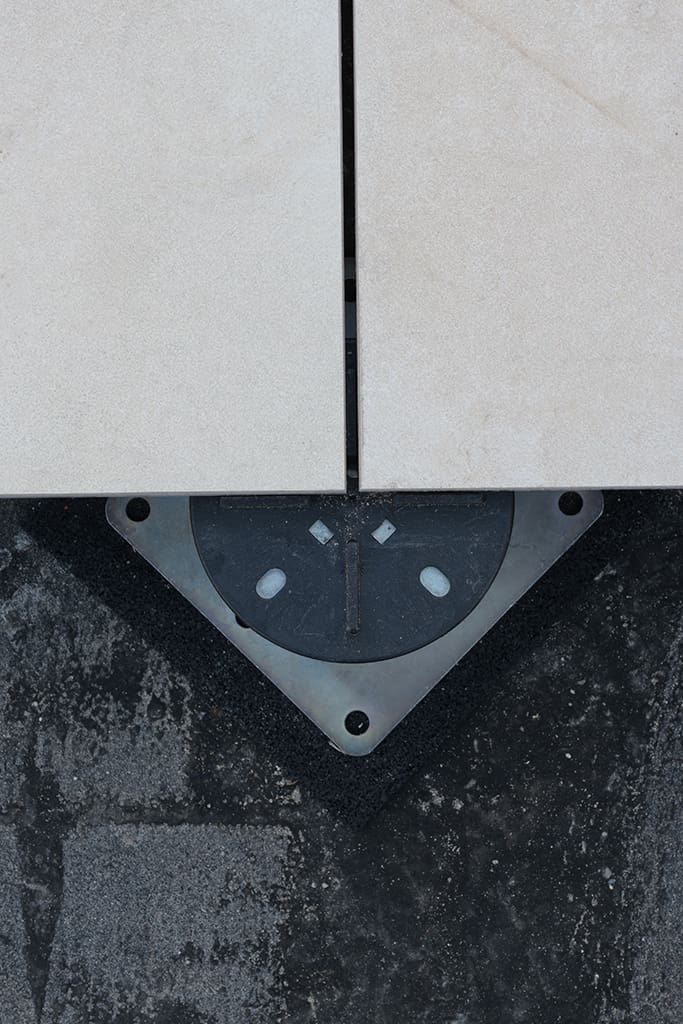
Broad-based adjustable paving pedestals distribute point loads more effectively, reducing long-term insulation compression.
Without proper load distribution:
- Insulation can compress
- Falls can distort
- Drainage performance reduces
- Surface movement increases over time
Calvin adds:
“Insulation isn’t designed to handle concentrated point loading indefinitely. If pedestal base geometry is too narrow, you’re increasing long-term compression risk.”
Tolerance management is equally critical. Roof decks are rarely perfectly level. A quality pedestal system must accommodate substrate variance while maintaining surface alignment.
“A good system absorbs deck imperfections below while delivering millimetre precision above. That’s where engineering detail matters more than catalogue price.”
For deeper technical reading:
Acoustics
Acoustic performance is frequently overlooked in residential roof terraces and balconies.
Lower-quality pedestal systems can:
- Rattle under foot traffic
- Transmit vibration through structure
- Amplify lateral movement noise
In multi-occupancy buildings, this becomes a compliance and reputation issue.
Quality pedestal systems incorporate:
- Dampening interfaces – reducing vibration transfer between tile and pedestal head
- Stable head connections – limiting micro-movement under load
- Reduced lateral movement – preventing impact noise transmission
Calvin notes:
“Most post-handover acoustic complaints aren’t about airborne noise. They’re about structure-borne vibration from unstable paving.”
Good acoustic behaviour reduces call-backs, protects developer reputation and improves occupant satisfaction.
Wind Uplift
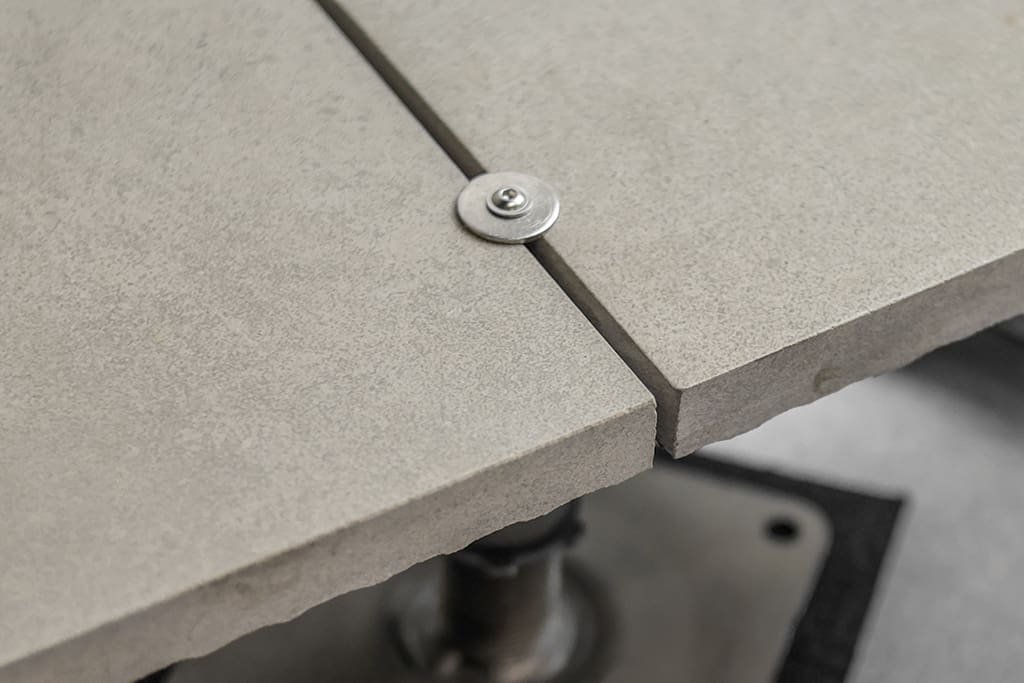
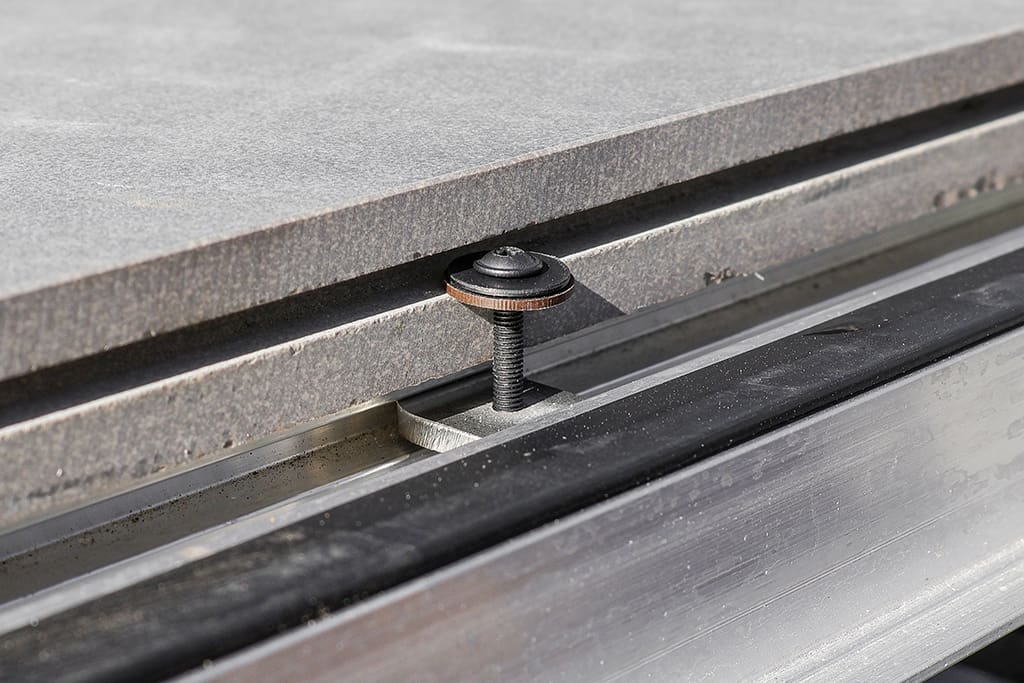
Lightweight finishes such as porcelain introduce significant wind uplift risk, particularly on elevated or exposed sites.
Wind pressure increases with building height and exposure category. On a 15-storey coastal scheme, uplift forces can be multiple times greater than on a low-rise inland podium.
A pedestal system for porcelain tiles must work with the surface, not independently of it.
Wind uplift mitigation may require:
- Increased system weight
- Mechanical restraint
- Rail-based stabilisation
- Connected or lattice systems
If uplift calculations are undertaken late, additional system depth or ballast may be required. Without build-up allowance, compliance becomes compromised.
Calvin explains:
“Wind uplift shouldn’t be an afterthought calculation. It should inform surface choice and system design from the start.”
For more detail, see our wind uplift resources page.
The Specification Checklist: Key Questions to Ask Early
To protect design intent and performance, pedestal considerations should begin at the concept stage.
To support this process, we created The Terrace Book, a comprehensive design-led guide that brings together everything architects need to specify roof terraces with confidence. From regulations and drainage to loading, finishes, and coordination, it provides clear answers to the questions that matter most.
If you’re working through the early design phases, these are the critical questions that should be addressed from the outset.
Early-stage checklist:
- What is the intended use? Residential, communal, hospitality?
- What are the expected static and dynamic loads?
- Are non-combustible paving pedestals required?
- What is the substrate slope versus finished floor level?
- Is there sufficient build-up to comply with BS 8579:2020 drainage guidance?
- Have wind uplift calculations been undertaken for this building height and exposure?
- What finish format is specified? Large-format porcelain? Natural stone?
- How will thermal expansion be accommodated?
- Is insulation rated for long-term point loading?
- Are thresholds coordinated with structural and waterproofing teams?
As Calvin summarises:
“If these questions aren’t answered at Stage 2, they’ll surface at Stage 4; just with fewer options available.”
How Integrated Systems Reduce Coordination Issues
A mix-and-match procurement approach introduces coordination risk.
Multiple suppliers mean:
- Diffused responsibility
- Separate warranties
- Increased interface risk
- Greater installation complexity
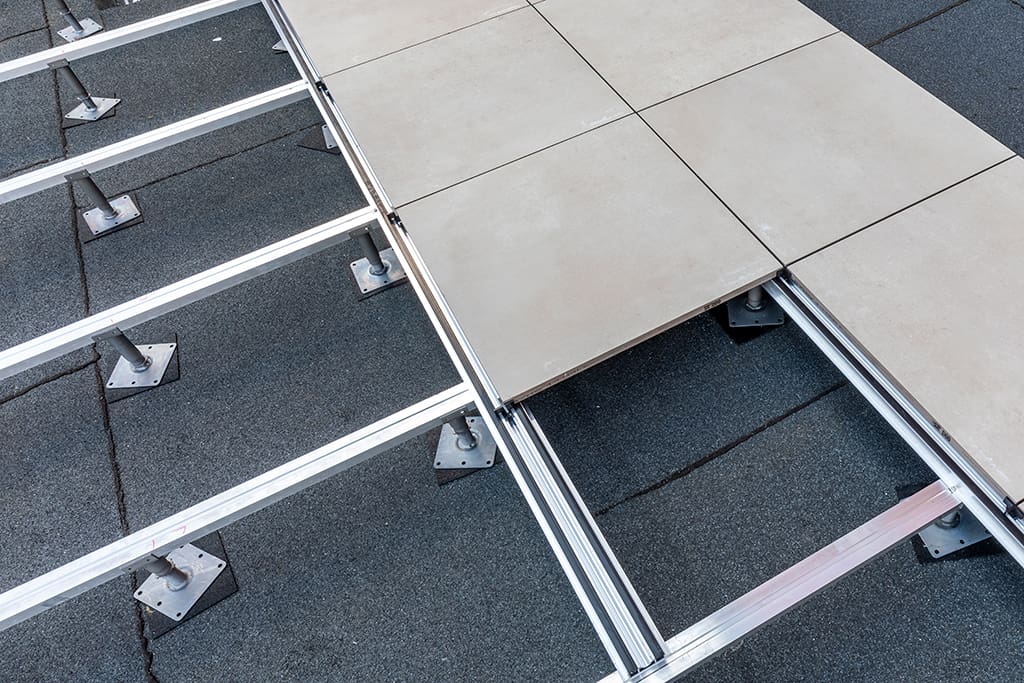
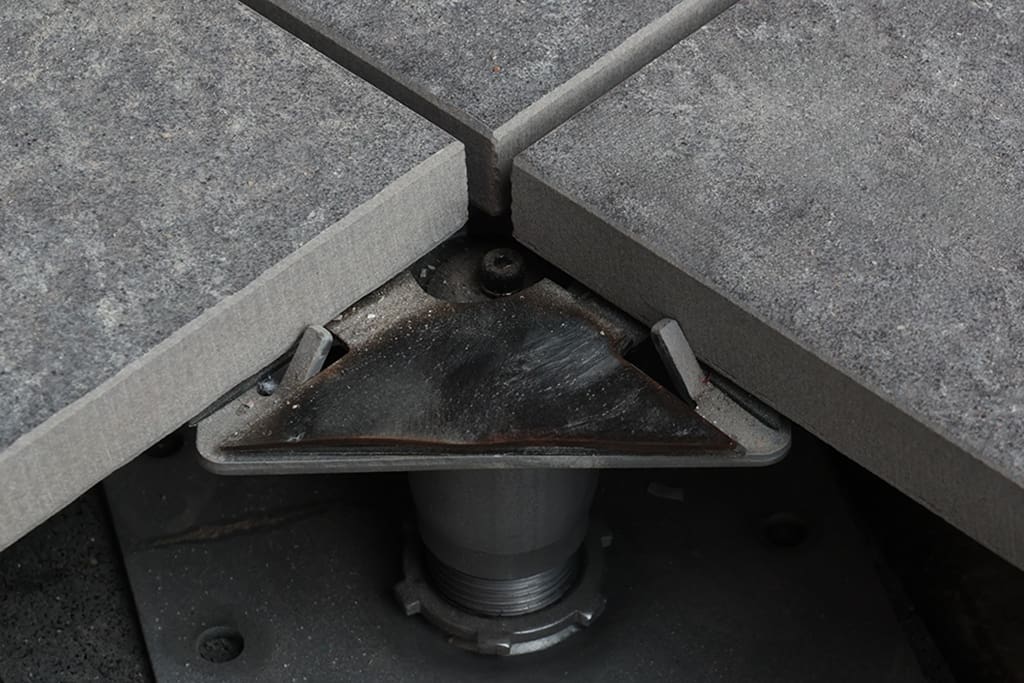
Integrated systems, such as our Smart Paving Systems, provide:
- Connected rail stabilisation
- Coordinated engineering
- Single-point accountability
- Simplified installation
Compared to a conventional pedestal paving system, a connected rail structure:
- Reduces lateral movement
- Improves long-term stability
- Enhances uplift resistance
- Simplifies alignment and spacing
For projects with strict fire requirements under Approved Document B, our Non-Combustible Pedestal Paving System supports compliance with Class A performance expectations, without aesthetic compromise.
Calvin advises:
“The more fragmented the system, the more assumptions creep in. Integrated engineering removes those grey areas.”
Designing for Longevity, Not Just Compliance
Compliance is the baseline. Longevity is the goal.
A roof terrace that technically meets regulations on day one but requires intervention five years later is not sustainable design.
Designing from the roof up:
- Protects insulation and waterproofing
- Reduces long-term settlement
- Minimises acoustic complaints
- Improves wind resilience
- Preserves aesthetic precision
Calvin concludes:
“The terrace might look perfect on completion day. The real test is how it performs after five winters, heavy foot traffic and high winds.”
Pedestal systems are not an afterthought. They are the foundation of performance.
If you are planning a roof terrace, balcony or podium deck, engage early. We will handle the load calculations, wind uplift considerations and coordination detail, so you can focus on delivering architectural intent with confidence.
Explore our Roof Terraces page or contact RYNO for project-specific advice.

Calvin Dalrymple
Head of Technical
Calvin leads technical compliance across terrace and balcony systems, helping specifiers navigate complex regulations and fire safety guidance. Outside work, he is usually outdoors, whether spear fishing, climbing Snowdon or perfecting a smoked Old Fashioned.